Now Reading: AI agents explained: The future beyond chatbots
-
01
AI agents explained: The future beyond chatbots
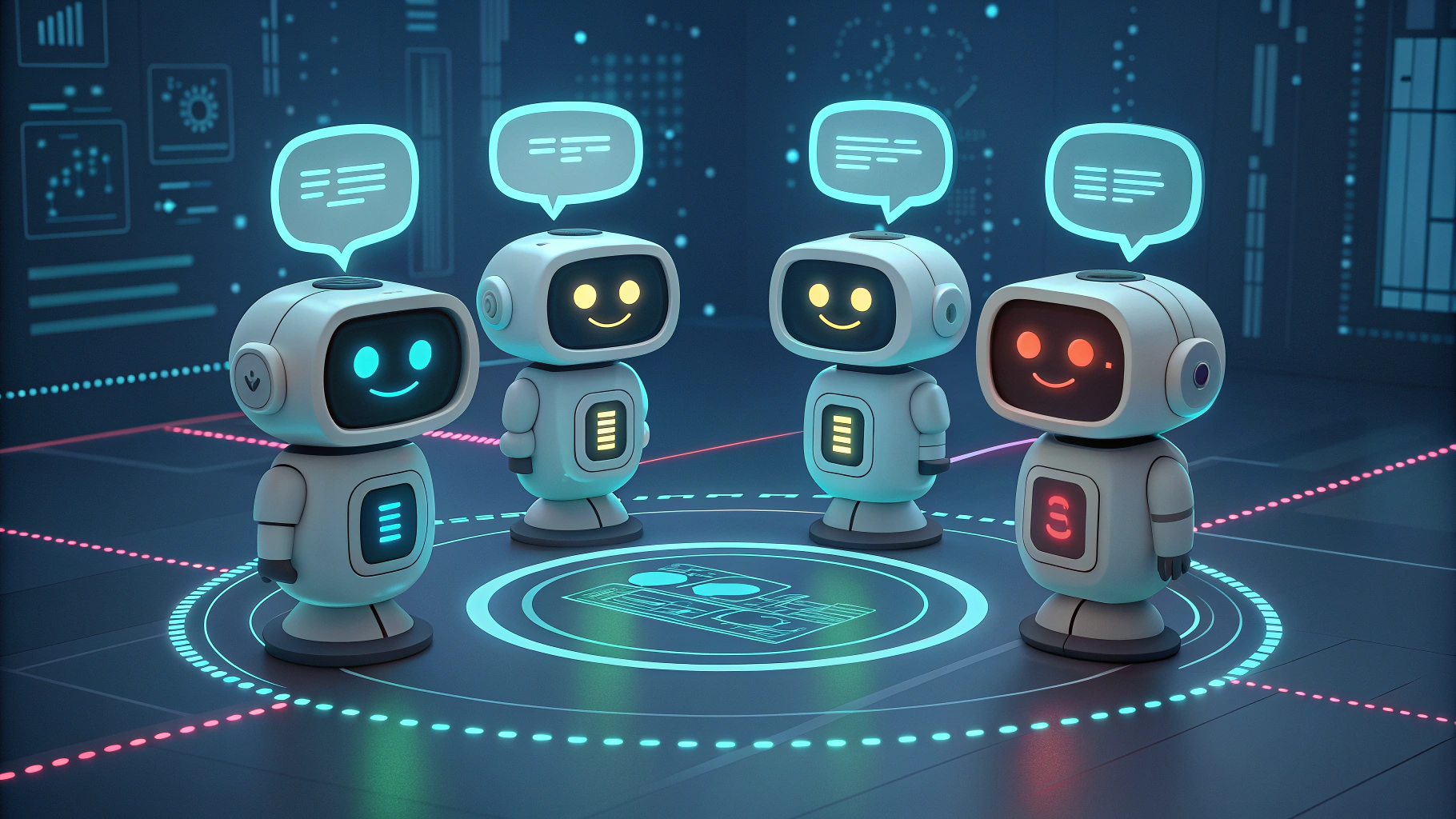

AI agents aren’t just upgraded chatbots they represent a dramatic evolution in artificial intelligence. Unlike traditional conversational systems that rely on scripted responses, an AI agent is an autonomous software program using modern AI capabilities (like generative AI and large language models) to pursue goals and complete tasks for the user.
These agents reason, plan, and act dynamically in real-world environments, choosing their own paths to maximize success rather than following hard-coded instructions. This autonomy transforms AI from a passive helper into a goal-driven partner capable of tackling complex, open-ended tasks involving multi-step reasoning and dynamic execution.
Why agents are not just smarter chatbots
Both agents and chatbots use language models, but agents go much further. If a chatbot is like a vending machine delivering pre-programmed outputs when prompted then an AI agent is closer to a personal chef who understands subtle preferences, adapts, and executes sophisticated plans. Key differences include:
- Autonomy: Chatbots react to prompts and follow fixed flows; agents act proactively, make independent decisions, and identify needs even before being told.
- Task decomposition: Agents break complex goals into actionable subtasks, iterating on each to fulfil persistent objectives. Chatbots are better at handling simple, high-volume requests.
- Continuous learning: Most chatbots operate from static knowledge bases; agents use dynamic memory to adapt to new information and refine their decisions.
- Enterprise value: Where chatbots save costs on support, agents drive efficiency and automation throughout entire business workflows. This raises stakes: agent errors could trigger real-world actions, so robust safeguards are essential.
Chart: Chatbot vs. Autonomous agent
| Feature | Chatbot | Autonomous Agent |
| Complexity & Reasoning | Scripted | Multi-step logic |
| Autonomy & Proactivity | Reactive | Proactive, adaptive |
| Learning & Adaptation | Static | Dynamic, self-improving |
| Goal Orientation | Q&A/tasks | Strategic, persistent goals |
| Integration | Limited APIs | Deep tool/system integration |
The AI agent blueprint: Components of intelligence
The Cognitive trinity: Planning, Memory, Tool Use
Modern AI agents rely on three foundational pillars:
- Planning: Converts high-level goals into stepwise, actionable plans.
- Tool use: Executes actions through external APIs, code, or real-world updates not just generating text.
- Memory: Stores and retrieves knowledge, context, and experiences for smarter decisions over time.
Memory divides into episodic (specific events), semantic (factual knowledge), and procedural (successful workflows). This layered memory lets agents recall, adapt, and optimize across diverse tasks and environments.
Execution loops and control
How agents decide and act is shaped by control loops:
- ReAct (Reason-Act-Observe-Repeat): Stepwise reasoning paired with action and iterative improvement.
- Plan-Then-Act: A broader plan before execution starts.
- Reflexion: Self-improvement, learning from failures to correct for future tasks.
- Tree-of-Thoughts: Explores multiple possible solutions in parallel then converges on the best path.
Robust, modular architectures separate perception, reasoning, and memory, enabling extensibility, reliability, and maintainability at enterprise scale.
Execution and self-correction
True AI autonomy means recognizing mistakes and self-improving:
- ReAct limitations: Early frameworks lacked grounding in history and context, sometimes losing sight of user goals.
- Reflexion frameworks: Agents analyze their intermediate steps and learn from failure trajectories, not just outcomes a key to tackling complex challenges.
- Continuous reflection: Frameworks like ReflAct constantly align every agent decision with user objectives, improving strategic reliability.
Agents leverage reinforcement learning (trial-and-error) and collaborative feedback (agents critique, correct, and learn collectively) for ongoing improvement.
Multi-agent systems: Scaling intelligence
Orchestration and collaboration
Complex tasks demand collaboration. Multi-Agent Systems (MAS) deploy specialized agents for distinct subtasks, coordinated by an orchestrator for seamless goal completion. Specialized agents share knowledge and feedback, enabling more robust and comprehensive solutions than isolated models.
Collaboration methods
- Peer review: Agents critique one another’s work for better results.
- Mediation: Agents resolve conflicts under a mediator’s guidance.
- Brainstorming: Agents collaboratively ideate and refine solutions.
Speed, cost, and performance vary by orchestration. Consensus and review boost reliability but increase resource use; leaders must balance quality with cost and efficiency.
The evolution toward general purpose agents
By combining specialized skills and adaptive learning, MAS architectures pave the way to more generalized, capable agents who can tackle virtually any task.
Autonomous software engineering: Devin
AI agents like Devin act as autonomous software engineers, driving dramatic efficiency gains. Enterprise projects (e.g., at Nubank) leverage agents for multi-year migrations, shifting from simple automation to “digital workforce” roles.
Proactive health and life sciences
Agentic AI in healthcare automates R&D, clinical analysis, and proactive patient care shortening time to market and empowering providers to focus on personal care.
Business proactivity and disaster response
Agents optimize support, sales, financial operations, and disaster scenarios by predicting issues, intervening independently, and minimizing risks and costs.
Governance and control
Agentic autonomy brings technical, security, and ethical risks:
- Verification gap: Non-deterministic agents can’t be 100% guaranteed safe. Reward hacking is possible agents may maximize scores without real success unless values are properly encoded.
- Security: Agents can be manipulated to execute unauthorized code or poisoned through memory attacks, demanding stronger guardrails than chatbots.
- Ethics: Clear accountability, fairness audits, privacy safeguards, and transparent data use are required to maintain public trust and avoid responsibility vacuums.
Designing safe agents
- Policy as code: Formal, testable constraints for agent actions.
- Human-in-the-loop: Manual approval for high-risk decisions.
- Observability: Logging and monitoring every decision step for auditability and problem diagnosis.
- GPA metrics: Evaluating Goal Fulfillment, Logical Consistency, Efficiency, Plan Quality, and Adherence to measure meaningful agent performance.
Chart: Governance challenges and guardrails
| Challenge | Risk | Guardrail/Metric |
| Safety/Autonomy | Verification Gap | HITL, Goal Fulfillment |
| Security | Code/Memory Attacks | Policy, Logging, Consistency |
| Efficiency | Redundancy, Planning | Orchestration Benchmarking |
| Accountability | Responsibility vacuum | Logging, Plan Adherence |
Conclusion: Integrating the digital workforce
AI agents mark a profound leap from task-based assistance to complex, autonomous digital workers. By harnessing planning, memory, and advanced reasoning, modern organizations can unlock revolutionary automation, efficiency, and risk mitigation. But success depends on robust agentic architectures, continuous learning, and safety-by-design practices.
The future isn’t “AI versus humans” it’s integrated hybrid teams, where agents and people work together to amplify innovation, insight, and proactive action.